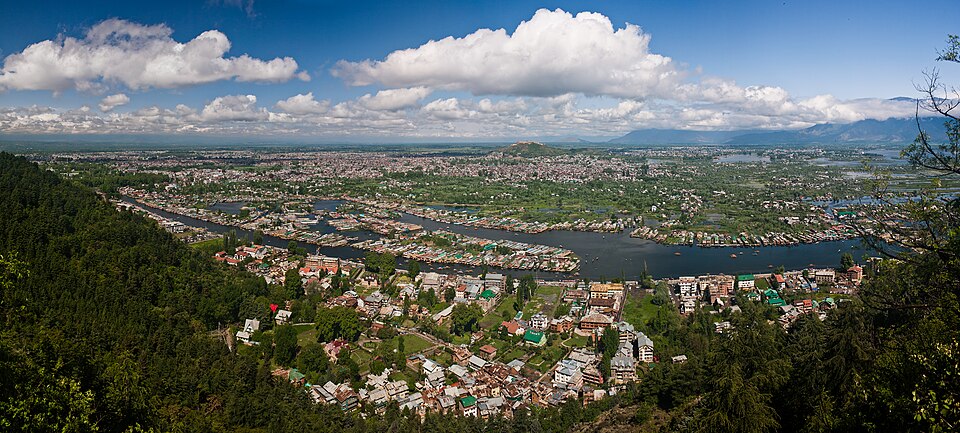
Srinagar ( ; Kashmiri: [siriːnagar]) is a city in Indian-administered Jammu and Kashmir in the disputed Kashmir region. It is the largest city and summer capital of Jammu and Kashmir, which is an Indian-administered union territory. It lies in the Kashmir Valley along the banks of the Jhelum River, and the shores of Dal Lake and Anchar Lakes, between the Hari Parbat and Shankaracharya hills. The city is known for its natural environment, various gardens, waterfronts and houseboats. It is also known for traditional Kashmiri handicrafts like the Kashmir shawl (made of pashmina and cashmere wool), papier-mâché, wood carving, carpet weaving, and jewel making, as well as for dried fruits. It is the second-largest metropolitan area in the Himalayas (after Kathmandu, the capital of Nepal).
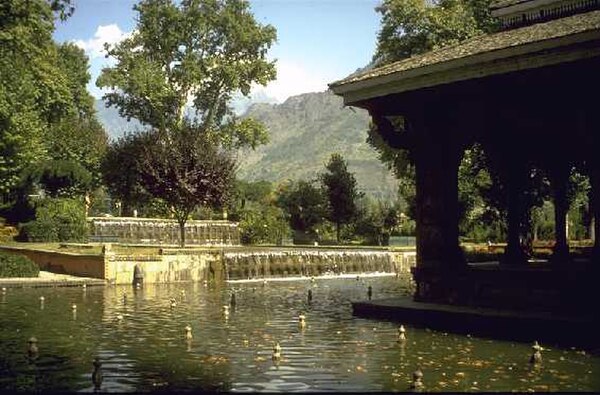
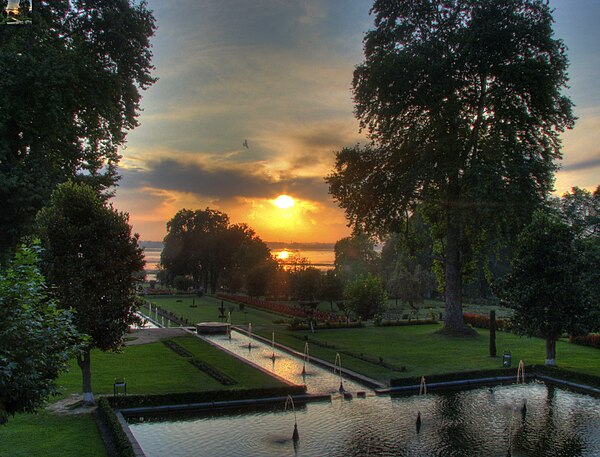
Founded in the 6th century during the rule of the Gonanda dynasty according to the Rajatarangini, the city took on the name of an earlier capital thought to have been founded by the Mauryas in its vicinity. The city remained the most important capital of the Kashmir Valley under the Hindu dynasties, and was a major centre of learning. During the 14th–16th centuries the city's old town saw major expansions, particularly under the Shah Mir dynasty, whose kings used various parts of it as their capitals. It became the spiritual centre of Kashmir, and attracted several Sufi preachers. It also started to emerge as a hub of shawl weaving and other Kashmiri handicrafts. In the late 16th century, the city became part of the Mughal Empire, many of whose emperors used it as their summer resort. Many Mughal gardens were built in the city and around Dal lake during this time, of which Shalimar and Nishat are the most well-known.
After passing through the hands of the Afghan Durranis and the Sikhs in the late 18th and early 19th century, it eventually became the summer capital of the Dogra kingdom of Jammu and Kashmir in 1846. The city became a popular tourist destination among Europeans and Indian elites during this time, with several hotels and its iconic houseboats being built. In 1952, the city became the summer capital of Jammu and Kashmir, a region administered by India as a state, with Jammu being its winter capital. It was the flashpoint of violence during the 1990s and early 2000s insurgency in the region. In 2019, it became the summer capital of a smaller region which is administered by India as a union territory, after the former state's reorganisation.
Places to Explore
Curated experiences in Srinagar
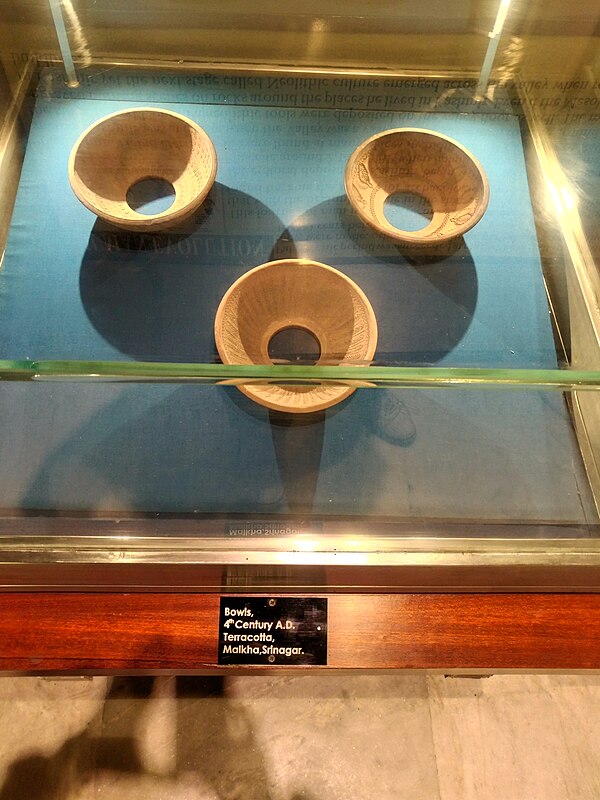
SPS Museum
The Shri Pratap Singh Museum, commonly known as the SPS Museum, is a museum in Wazir Bagh Srinagar, Jammu and …
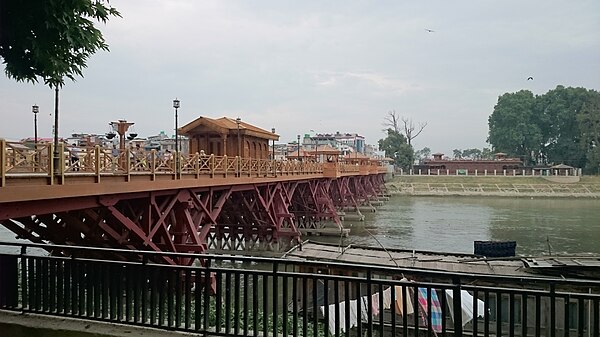
Zero Bridge
Zero Bridge (Urdu pronunciation: [ziːɾoː bɾɪd͡ʒ] ; Kashmiri pronunciation: [zərʲ kəd̪ɨl]) is a wooden arch pedestrian bridge in Srinagar, Jammu …
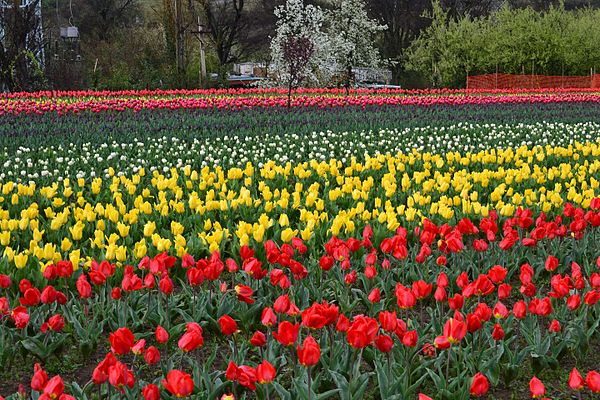
Indira Gandhi Memorial Tulip Garden
Indira Gandhi Memorial Tulip garden, previously Model Floriculture Center, is a tulip garden in Srinagar, in the Indian union territory …
Shalimar Bagh
Shalimar Bagh (Urdu pronunciation: [ʃɑːliːmɑːr bɑːɣ] ; Kashmiri pronunciation: [ʃaːlɨməːr baːɣ]) is a Mughal garden in Srinagar of Indian-administered Jammu …
Nishat Bagh
Nishat Bagh (lit. 'Garden of Joy' or 'Garden of Delight') is a terraced Mughal garden built on the eastern bank …
Lal Chowk
Lal Chowk (lit. 'Red Square') is a city square in Srinagar, in the Indian union territory of Jammu and Kashmir. …
Begin Your Journey
Create a personalized itinerary and unlock the finest experiences Srinagar has to offer